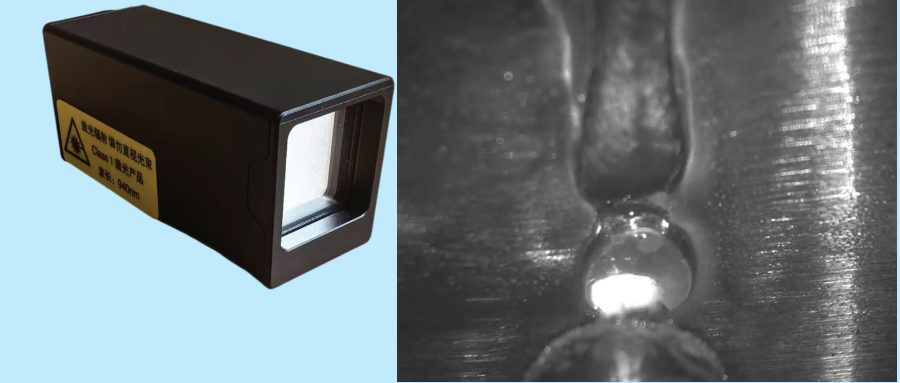
In advanced manufacturing processes such as welding and Wire Arc Additive Manufacturing (WAAM), the morphology and behavior of the melt pool directly determine the forming quality and mechanical properties. Traditional visual inspection or indirect parameter monitoring struggles to accurately capture the dynamic changes of the melt pool. The melt pool monitoring welding camera, through high dynamic range imaging, narrow-band filtering, and real-time video streaming, provides operators and control systems with a clear and stable view of the melt pool. Its professional advantages are reflected in the following aspects:
1. Real-Time Process Visualization for Enhanced Process Stability
The welding camera can overcome arc glare interference, clearly presenting the melt pool boundary, flow patterns, keyhole behavior, and spatter details. Operators can assess the penetration status and melt pool stability in real time from a safe distance away from high-temperature radiation, allowing timely adjustment of welding parameters to prevent defects such as lack of fusion, undercuts, or porosity.
2. Precise Interlayer Quality Control in Additive Manufacturing
In WAAM, the morphology and overlap accuracy of each deposited layer are critical to the performance of the final component. The melt pool camera can record, layer by layer, the melt pool width, wetting angle, and deposition offset, assisting a closed-loop control system to dynamically adjust heat input and travel speed. This results in uniform layer height, dense microstructure, and good sidewall bonding.
3. Early Defect Warning and Quality Traceability
When combined with image processing algorithms, the camera system can automatically identify abnormal melt pool characteristics (e.g., excessive spread, liquid metal spatter, or sudden penetration changes), triggering alarms or automatic shutdown to contain potential scrap at an early stage. Meanwhile, the recorded melt pool videos serve as objective evidence for process qualification and quality traceability, meeting stringent requirements in high-end manufacturing sectors such as aerospace and energy.
4. Enabling Automated and Intelligent Welding
The melt pool monitoring camera is a key sensor for implementing “see-decide-act” closed-loop control. Its image data can be integrated into robot control systems or machine learning models to drive adaptive adjustments of torch posture, wire feed speed, or current waveform, providing reliable visual feedback for unattended smart welding workshops and adaptive additive manufacturing.
In summary, the melt pool monitoring welding camera transparently reveals melt pool behavior, significantly reducing process trial costs and improving product consistency and reliability. Whether in conventional welding or additive manufacturing of complex structural components, this technology has become an important tool for elevating quality control and production efficiency.